


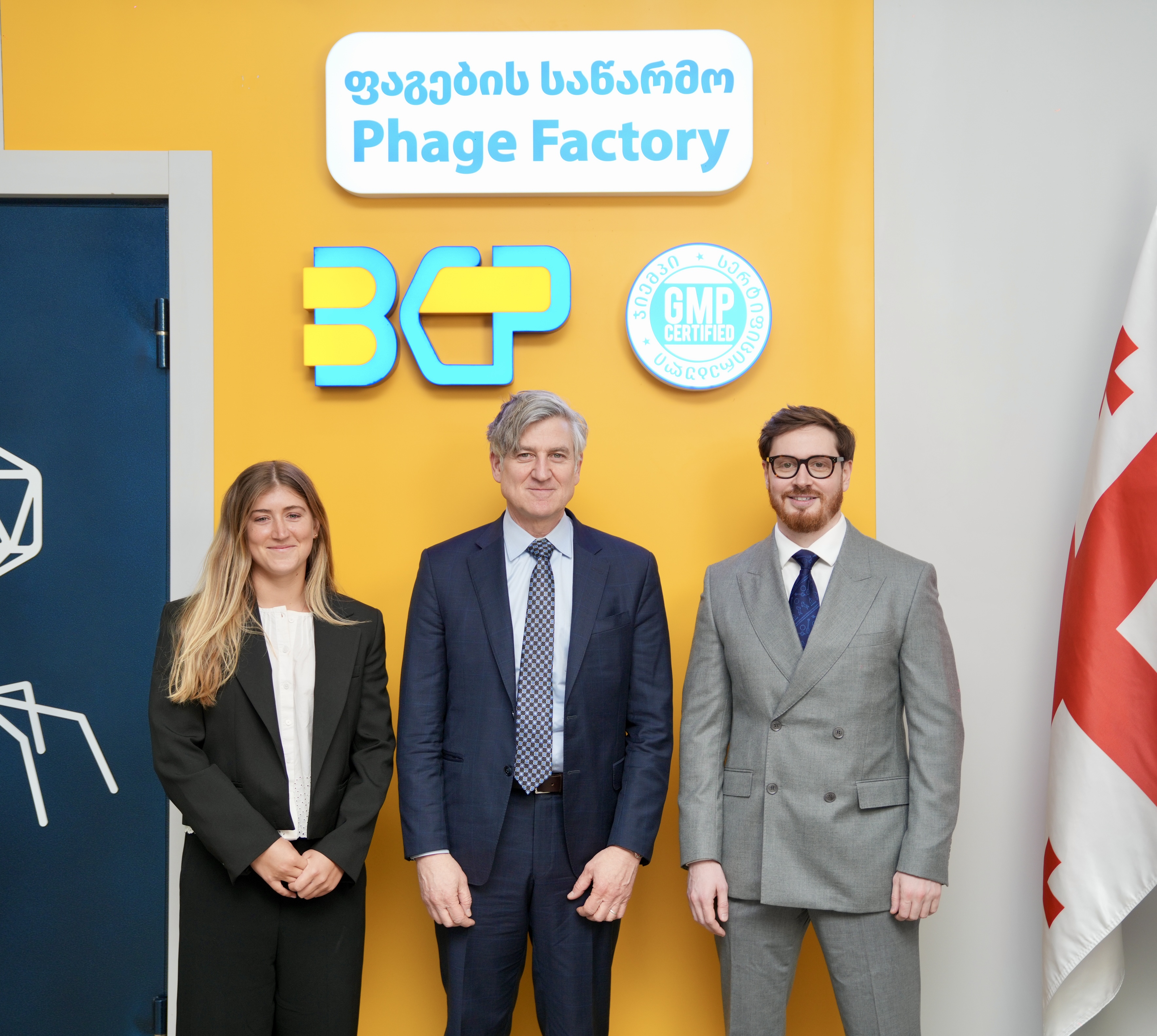
The former Medical Director of the Centers for Disease Control and Prevention (CDC), Mitchell Wolfe, visited BioChimPharm’s Phage Factory

The former Medical Director of the Centers for Disease Control and Prevention (CDC), Mitchell Wolfe, visited BioChimPharm’s Phage Factory.
As part of the visit, BioChimPharm’s team hosted the guests on a “Phage tour”. The delegation visited a newly modernized, state of the art - GMP standard compliant, historic phage manufacturing facility, where they were introduced to the manufacturing process of the product Phagyo® and other phage-based pharmaceutical products. Together with the company’s General Manager, Rati Golijashvili, the parties discussed potential opportunities for collaboration, the critical role of phages in addressing the global challenge of antibiotic resistance, and their potential in modern medicine.
“Infections and antibiotic resistance don’t recognize any geographical borders. They pose the same challenge in Georgia, the United States and across the world. It is essential that we address this complex global issue by leveraging every available opportunity, best practices, modern technologies and collaboration. Georgian phages and phage therapy can make a significant contribution in the fight against antibiotic resistance.
We are proud that phages and Georgia, as a pioneering country in phage R&D and production, are attracting global attention, especially from professionals with such extensive experience as Mr. Mitchell Wolfe, who served for many years as the Medical Director of the CDC. During the meeting, we discussed details of potential partnerships and hope to collaborate in the future in the fight against antibiotic resistance.” - Rati Golijashvili, General Manager of BioChimPharm.

Most Read


Other News
08.02.2026.00:29
 Ambassadori Island Batumi to Deliver a High-Quality Urban Environment and Sustainable Ecosystem – ARUP
09.02.2026.14:03
In collaboration with the global company Arup, "Ambassadori Island Batumi" is developing a unique architectural concept featuring two artificial peninsulas and a artificial island. This strategic partnership ensures a cohesive, sustainable architectural vision that integrates seamlessly with Batumi’s natural coastal landscape. With 95 offices across 37 countries and a workforce of over 19,000 professionals, Arup brings world-class expertise to this development, which is set to become a pivotal center for future urban growth.
"The Ambassadori Island Batumi project will provide the region with a high-quality urban environment and a sustainable ecosystem. It holds significant potential to become a new landmark for both tourists and investors. As the first large-scale artificial island in the Black Sea region, it is designed to be a premier international destination, while remaining, first and foremost, a space created for the citizens of Batumi," stated Alev Çakmak, Architect and Associate Director at Arup.
As part of the master plan, Arup has developed a Smart City framework designed to maximize the site’s potential through innovative technology and space management.
"During the development of the master plan, particular emphasis was placed on eco-friendly mobility and innovative transit solutions. This includes exploring the implementation of sea taxis and air taxis to ensure a future-ready transportation network," added Mustafa Ay, Senior Urban Planner at Arup.
Emine Kazanc, Arup’s Portfolio Leader for Energy and Water Resources, highlighted that the project’s sustainability strategy is built upon several critical pillars: Decarbonization: Integrating renewable energy sources and high-efficiency thermal insulation; Circular Economy: Establishing a comprehensive waste management framework, and Blue-Green Infrastructure:
Arup’s role is instrumental in realizing the innovative and sustainable vision of Ambassadori Island. The company’s iconic global portfolio includes landmarks such as the Sydney Opera House (Australia), Marina Bay Sands (Singapore), the Beijing National Stadium (China), and the Bosco Verticale (Italy), among others. Their regional expertise is further highlighted by the Samarkand Silk Road Tourist Center (Uzbekistan), the Konya Tropical Butterfly Garden (Turkey), and the Hilton Tashkent City (Uzbekistan).
 Ambassadori Island Batumi Allows Us to Fully Realize Our Decades of Engineering Expertise – Yüksel Proje
09.02.2026.12:36
Ambassadori Island Batumi Allows Us to Fully Realize Our Decades of Engineering Expertise – Yüksel Proje
09.02.2026.12:36
 The former Medical Director of the Centers for Disease Control and Prevention (CDC), Mitchell Wolfe, visited BioChimPharm’s Phage Factory
06.02.2026.13:33
The former Medical Director of the Centers for Disease Control and Prevention (CDC), Mitchell Wolfe, visited BioChimPharm’s Phage Factory
06.02.2026.13:33
 Tbilisi Waterfront Achieves Day One Sell-Out, as Georgian Buyers Lead Demand for a New Landmark Destination
03.02.2026.10:39
Tbilisi Waterfront Achieves Day One Sell-Out, as Georgian Buyers Lead Demand for a New Landmark Destination
03.02.2026.10:39


